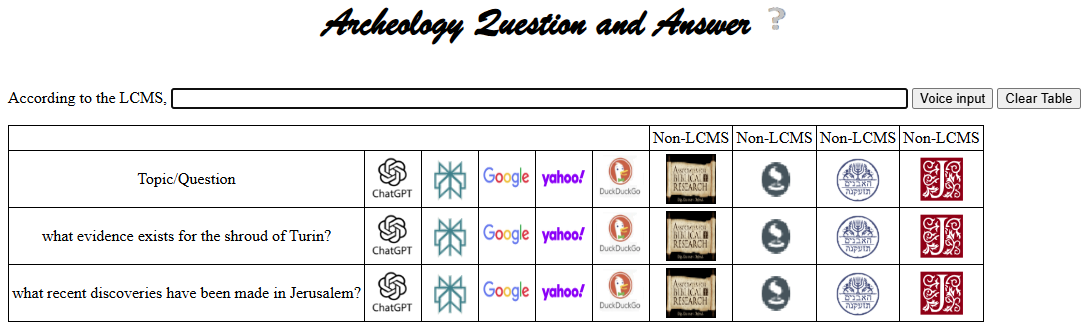
The “Archeology Question and Answer” webpage is an LCMS-oriented research tool that enables users to enter or dictate questions about biblical archaeology, historical settings, artifacts, ancient cultures, or the reliability of Scripture and then explore related resources. Each submitted topic appears in a table with links to generate an LCMS-framed article, identify sermon points, create a Bible study or devotional, and search LCMS sermon material, while additional links direct users to non-LCMS archaeology and academic sources: Associates for Biblical Research, the Biblical Archaeology Society, the Armstrong Institute of Biblical Archaeology, and JSTOR. The page can also receive multiple questions through a URL parameter, allowing a prepared series of topics to be loaded for study. By combining Lutheran teaching tools with archaeological and scholarly research sites, it is designed to help users investigate the historical world of the Bible while recognizing that archaeology can illuminate Scripture’s context but does not replace Holy Scripture as the Church’s final authority for faith and doctrine.
The first step is to enter a question by keyin to the text field or by voice input. This will add the question, prefixed with "According to the LCMS," to the table. Once a question has been added to the table, any of the images for a row can be used to address that question by clicking on that image.
The descriptions below were generated with the assistance of the Perplexity chatbot.
 The Article image sets the default chatbot prefix for the Chatbot Q&A webpage to "write an article on". The Lutheran Hub "Chatbot Q&A" webpage is an online question-and-answer resource designed to help users explore biblical, theological, and practical Christian questions through a chatbot-style format, likely drawing on Lutheran and LCMS-oriented assumptions. From an LCMS perspective, such a tool may be useful as a starting point for study, reflection, or locating relevant biblical themes, particularly if it encourages users to read Scripture carefully and directs them toward Christ's saving work. Yet it should not be treated as an official LCMS source, a substitute for the pastor's office, or an authority alongside Holy Scripture and the Book of Concord; AI-generated answers can be incomplete or mistaken and must be tested against the Scriptures, which the LCMS confesses as the inspired Word of God and the sole rule and norm of doctrine. For questions involving doctrine, conscience, spiritual distress, or pastoral care, the proper next step is consultation with a faithful pastor and participation in the Church's preaching and sacramental life.
 The Sermon Q&A image sets the default chatbot prefix for the Chatbot Q&A webpage to "identify 5 points to include for sermon on". The Lutheran Hub "Chatbot Q&A" webpage is an online question-and-answer resource designed to help users explore biblical, theological, and practical Christian questions through a chatbot-style format, likely drawing on Lutheran and LCMS-oriented assumptions. From an LCMS perspective, such a tool may be useful as a starting point for study, reflection, or locating relevant biblical themes, particularly if it encourages users to read Scripture carefully and directs them toward Christ's saving work. Yet it should not be treated as an official LCMS source, a substitute for the pastor's office, or an authority alongside Holy Scripture and the Book of Concord; AI-generated answers can be incomplete or mistaken and must be tested against the Scriptures, which the LCMS confesses as the inspired Word of God and the sole rule and norm of doctrine. For questions involving doctrine, conscience, spiritual distress, or pastoral care, the proper next step is consultation with a faithful pastor and participation in the Church's preaching and sacramental life.
 LCMSSermons is an unofficial online repository of sermon manuscripts and preaching resources associated with pastors and congregations of the Lutheran Church - Missouri Synod. Its purpose is to provide examples of Christ-centered, Law-and-Gospel preaching on appointed lectionary texts and other biblical passages, giving pastors, seminarians, teachers, and lay readers material for sermon study and devotional reflection. Unlike the LCMS Document Library or LCMS Worship resources, which are official Synod platforms offering vetted worship-planning, lectionary, Bible-study, and congregational materials, LCMSSermons should be understood as a supplementary resource rather than an authoritative voice of the Synod. Individual sermons vary according to their authors, contexts, and theological emphases, so they are best used as aids for engaging the biblical text - not as material to reproduce uncritically. For LCMS use, every sermon should be evaluated in light of Holy Scripture, the Lutheran Confessions, the church year's propers, and the pastoral responsibility to preach repentance, forgiveness, Christ crucified, and the gifts of Word and Sacrament.
 The Bible Studies Q&A image sets the default chatbot prefix for the Chatbot Q&A webpage to "create Bible study for". The Lutheran Hub "Chatbot Q&A" webpage is an online question-and-answer resource designed to help users explore biblical, theological, and practical Christian questions through a chatbot-style format, likely drawing on Lutheran and LCMS-oriented assumptions. From an LCMS perspective, such a tool may be useful as a starting point for study, reflection, or locating relevant biblical themes, particularly if it encourages users to read Scripture carefully and directs them toward Christ's saving work. Yet it should not be treated as an official LCMS source, a substitute for the pastor's office, or an authority alongside Holy Scripture and the Book of Concord; AI-generated answers can be incomplete or mistaken and must be tested against the Scriptures, which the LCMS confesses as the inspired Word of God and the sole rule and norm of doctrine. For questions involving doctrine, conscience, spiritual distress, or pastoral care, the proper next step is consultation with a faithful pastor and participation in the Church's preaching and sacramental life.
 The Devotions Q&A image sets the default chatbot prefix for the Chatbot Q&A webpage to "create devotional for". The Lutheran Hub "Chatbot Q&A" webpage is an online question-and-answer resource designed to help users explore biblical, theological, and practical Christian questions through a chatbot-style format, likely drawing on Lutheran and LCMS-oriented assumptions. From an LCMS perspective, such a tool may be useful as a starting point for study, reflection, or locating relevant biblical themes, particularly if it encourages users to read Scripture carefully and directs them toward Christ's saving work. Yet it should not be treated as an official LCMS source, a substitute for the pastor's office, or an authority alongside Holy Scripture and the Book of Concord; AI-generated answers can be incomplete or mistaken and must be tested against the Scriptures, which the LCMS confesses as the inspired Word of God and the sole rule and norm of doctrine. For questions involving doctrine, conscience, spiritual distress, or pastoral care, the proper next step is consultation with a faithful pastor and participation in the Church's preaching and sacramental life.
 Associates for Biblical Research (ABR) is a nonprofit evangelical Christian apologetics ministry devoted to demonstrating and defending the historical reliability of the Bible through archaeological fieldwork, scholarly research, publications, educational resources, and public outreach. ABR approaches its work from the conviction that Scripture is God's inspired, inerrant, and authoritative Word in its original writings, and it seeks to investigate archaeological, historical, and cultural evidence that illuminates the biblical world and responds to criticisms of the Bible's trustworthiness. Its work includes original archaeological projects, such as research connected with sites and events in the Old Testament, as well as articles, videos, podcasts, and teaching materials intended to equip Christians, assist the Church, and help interested inquirers understand the historical setting of Scripture. From an LCMS perspective, its archaeological resources can be useful, but its evangelical conclusions and interpretive claims should be evaluated carefully in light of Holy Scripture and the Lutheran Confessions.
 The Biblical Archaeology Society (BAS) is a nonprofit, nonsectarian educational organization founded in 1974 to make archaeological research from the lands and cultures of the Bible understandable and accessible to the general public. Its principal publication, Biblical Archaeology Review, along with its website, books, seminars, tours, and opportunities for volunteers to participate in excavations, brings together scholarly discussion of inscriptions, artifacts, ancient sites, historical settings, and ongoing discoveries that illuminate the world in which the biblical texts emerged. BAS aims to present current archaeological scholarship fairly and accessibly rather than to function as a devotional or denominational ministry, drawing on work by scholars from differing religious and academic perspectives. From an LCMS viewpoint, it can be a valuable background resource for studying Scripture's historical context, though its conclusions should be assessed carefully under the authority of Holy Scripture rather than treated as a final authority for Christian doctrine.
 The Armstrong Institute of Biblical Archaeology (AIBA) is a nonprofit academic and educational organization headquartered in Jerusalem, Israel, that sponsors and participates in archaeological excavations and seeks to promote the study of Israel's biblical archaeology. Supported by Herbert W. Armstrong College in Edmond, Oklahoma, the institute presents archaeological discoveries through articles, scientific reports, documentaries, podcasts, interactive maps, museum-style exhibits, and its bimonthly magazine, Let the Stones Speak. AIBA especially highlights the archaeological legacy of Dr. Eilat Mazar and Professor Benjamin Mazar, interprets discoveries in relation to the biblical text, and argues that the Bible should be considered a credible and significant historical source in archaeological research. From an LCMS perspective, its material may offer useful historical and archaeological background, but because it is not an LCMS or confessional Lutheran institution, its theological and interpretive conclusions should be evaluated under the authority of Holy Scripture and in harmony with the Lutheran Confessions.
 JSTOR is a nonprofit digital library that provides access to scholarly journals, academic books, research reports, images, and primary-source materials for students, educators, researchers, and the public. Founded in 1995 to digitize and preserve academic journal backfiles, it has grown into a major interdisciplinary research platform used by more than 11,000 educational and cultural institutions worldwide. JSTOR's collections include peer-reviewed and respected literary journals, monographs, archival documents, and millions of visual sources, many of which are searchable in full text and available as scans of original publications. Although some material requires access through a subscribing institution or individual account, JSTOR also offers substantial free and open-access content. For theological or biblical study, it can be a valuable tool for locating academic work in biblical studies, church history, historical theology, archaeology, philosophy, literature, and related disciplines, while readers should still assess scholarly arguments critically in light of their confessional commitments and primary sources.