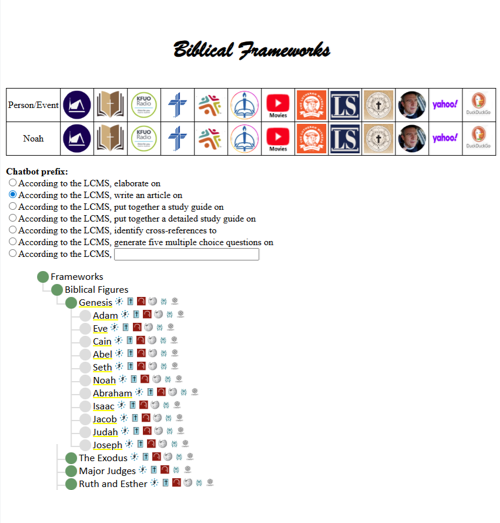
The Lutheran Hub Biblical Frameworks page is a study tool that organizes Scripture into major theological and historical themes to help users see how individual passages fit into the Bible's larger narrative and the Lutheran Church - Missouri Synod's doctrinal teaching. It presents frameworks for books such as Genesis, beginning with themes like creation, the order of creation, marriage, and the historical record from Adam onward, and uses these categories to connect biblical events, teachings, and doctrines across Scripture. By offering structured topic pathways rather than only a chapter-by-chapter index, the page helps readers approach the Bible with attention to its overarching story, key themes, and Christ-centered theological unity.
Entering text into the Add field will add a row to the table. Likewise, clicking yellow-underlined text from the Frameworks tree will add that Bible passage (or other topic) to the table.
Clicking the image for a chatbot for a row in the table will append the topic for that row to the specified chatbot prefix and send the request to the selected chatbot. Note that the chatbots starting with ChatGPT require pasting into the input field for the chatbot.
Clicking the framework icon ( ) will display the framework for that topic. Clicking one of the other images or hyperlinked text will display that webpage. The tooltip text should be used to differentiate when multiple images of the same type are included for the same node.
Specifying the particular section using "#section name" as part of the URL will locate and highlight that section and add it to the table at the top.

 Brave's AI chatbot, Leo, is a privacy-first conversational assistant built directly into the Brave browser and integrated with Brave Search. Launched in late 2023, Leo leverages multiple large language models - including Meta's Llama, Anthropic's Claude, Google's Gemma, and others - to summarize webpages, answer questions, translate content, analyze documents (PDFs, Google Docs, Sheets), and generate text or code. Unlike many AI assistants, Leo requires no account or login for free-tier use, discards chat history after sessions (or stores it only locally if enabled), anonymizes requests via reverse proxies to delink them from IP addresses, and explicitly does not retain user data or use conversations for model training. Premium subscribers ($15/month) gain access to faster responses and advanced models like Claude. Integrated with Brave Search, Leo can pull real-time web results to enhance answers and now supports "Skills" for saved prompts and "AI browsing" for automated multi-step tasks. Positioned as a privacy-conscious alternative to ChatGPT, Bing Copilot, and Google Gemini, Leo processes over 22 million AI answers daily via Brave's Zero Data Retention Search API.
 Gamaliel is a free, open-source AI-powered Bible study companion launched in 2025 by tech entrepreneur Lew Cirne and funded by the Beloved in Christ Foundation. Designed for users from curious seekers to seasoned theologians, it answers Scripture questions with biblically grounded responses, provides historical and linguistic context, compares denominational interpretations (Catholic, Reformed, LCMS-aligned, Charismatic, Orthodox, etc.), and links directly to relevant Bible passages. The app requires no login, stores no user data, and publishes all AI prompts and theological guardrails openly on GitHub for transparency and community review. Available on iOS, Android, and web (gamaliel.ai), Gamaliel also includes a "Watch" section with curated sermons and teaching videos from trusted ministries like BibleProject, Ligonier, and Billy Graham Evangelistic Association, each tied to specific Scripture references. Positioned as a privacy-first, theologically accountable alternative to general-purpose AI chatbots, it aims to deepen personal Bible engagement without replacing pastoral teaching or communal study.
 Google's AI chatbot and search engine are now deeply integrated under the Gemini brand, with Google Search featuring AI Overviews - AI-generated summaries that appear above traditional blue links for over 60% of queries as of 2025 - and AI Mode, a conversational interface powered by the Gemini 3.5 Flash model that allows multi-turn follow-ups and agentic task delegation. Gemini, Google's multimodal large language model, serves as the backbone for both the chatbot (accessible via gemini.google.com, the Google app, and Android) and Search enhancements, offering real-time web retrieval, image/video/file upload analysis, and deep integration with Gmail, Docs, Sheets, Maps, and YouTube. Free users get Gemini 3 Flash with basic Workspace extensions, while Gemini Advanced subscribers ($20/month) gain access to Gemini 3 Pro, a 1-million-token context window, Deep Research, AI agents, and 2 TB of Google One storage. Unlike standalone chatbots, Gemini leverages Google's vast ecosystem to pull live data (flight prices, news, local business info) and automate tasks across apps, positioning it as both a research assistant and productivity tool, though critics note AI Overviews can reduce website clicks and occasionally surface inaccurate summaries.
 Perplexity AI is an AI-powered conversational search engine and chatbot that delivers real-time, source-cited answers by combining large language models (including GPT-5, Claude Opus, and Gemini) with live web search, distinguishing itself from standalone chatbots by prioritizing citation transparency and factual grounding. Launched in 2022 and serving over 45 million users by 2026, it offers unlimited basic searches on its free tier, with Pro Search (deep research using hundreds of sources) limited to ~5 queries/day; paid plans ($20/month Pro, $200/month Max) unlock 300+ daily Pro Searches, advanced models, file/PDF upload and analysis, image/video generation, and agentic tools like the Comet AI browser and Perplexity Computer for autonomous workflows. Unlike Google or ChatGPT, Perplexity performs a fresh web search for every query, synthesizes answers with inline numbered footnotes linking directly to sources, and offers features like Model Council (comparing outputs from multiple AI models), Spaces for organizing research, and voice search via mobile apps. Positioned as an "answer engine" rather than a traditional search bar or pure chatbot, it aims to reduce information overload by delivering concise, verified responses while driving traffic to cited websites, making it popular among researchers, students, and professionals seeking accuracy over engagement.
 Yahoo's AI chatbot and search engine are unified under Yahoo Scout, an AI-powered answer engine launched in January 2026 that delivers conversational, source-cited responses using Anthropic's Claude large language model combined with Microsoft Bing's grounding API for real-time web retrieval. Integrated across Yahoo's ecosystem - including Mail, News, Finance, and Sports - Scout provides features like email summarization, stock analysis, game recaps, and daily news digests, leveraging Yahoo's 500+ million user profiles, 1 billion knowledge-graph entities, and 18 trillion consumer signals to personalize results. Accessible via scout.yahoo.com and the Yahoo Search app (iOS/Android), Scout emphasizes transparency with inline blue-highlighted citations linking directly to sources, vibrant emoji-driven UI, and rich embedded widgets (e.g., Yahoo Finance tables, weather, news highlights). Positioned as a "fun," visually engaging alternative to Google and Perplexity, Yahoo Scout represents Yahoo's strategic pivot to AI-first search and advertising, aiming to convert first-party intent data from its vast content network into actionable insights for both users and advertisers.
 ChatGPT is OpenAI's flagship AI chatbot, powered by the GPT-5 family of models (including GPT-5.5 Instant, Thinking, and Pro variants as of mid-2026), offering conversational text generation, code writing, image creation via DALL-E 3, advanced data analysis, and real-time web browsing with source citations. Launched in November 2022 and serving hundreds of millions of users, it features persistent memory (on paid tiers), custom GPTs, voice mode, file/PDF upload and analysis, and agentic tools like Deep Research (multi-step web investigations) and Codex (autonomous coding workflows). The free tier provides limited access to GPT-5.5 Instant (~10 messages per 5 hours), while Plus ($20/month) unlocks higher usage limits, GPT-5 Thinking mode, 25 Deep Research reports/month, and priority access to new features; Pro ($200/month) adds GPT-5.5 Pro, unlimited advanced tools, and expanded Sora video generation (though Sora was discontinued in April 2026). Accessible via chat.openai.com, mobile apps (iOS/Android), and API integrations, ChatGPT remains the most widely used AI assistant globally, competing with Google Gemini, Claude, and Perplexity through its broad ecosystem, third-party plugins, and deep customization options.
 Claude is Anthropic's AI chatbot family, powered by the Claude 5 series (including Opus 5, Sonnet 5, Haiku 4.5, and the flagship Fable 5 released in mid-2026), designed for helpful, honest, and harmless interactions with strong emphasis on safety, reasoning, and long-context understanding. Launched in March 2023, Claude offers features like web search with citations, file/PDF upload and analysis, persistent memory across conversations, Projects (organized workspaces), Artifacts (live code/document previews), and agentic tools such as Claude Code (autonomous programming), Cowork (Google Workspace/Microsoft 365 integration), and Dispatch (remote task execution from mobile devices). The free tier provides access to Claude Sonnet 4.6 with ~5–15 messages/day, while Pro ($20/month) unlocks 5× higher usage limits, full Opus 5 access (1M-token context window, 128k output tokens), Claude Code, Cowork, priority processing, and early feature rollouts; Max tiers ($100–200/month) offer 25–100× Pro limits for enterprise-scale agent deployments. Accessible via claude.ai, mobile apps (iOS/Android), and API integrations (including Google Cloud Vertex AI), Claude competes with ChatGPT and Gemini through its focus on transparency, reduced hallucination rates, and robust tool-use capabilities for coding, research, and professional workflows.
 Microsoft Copilot is an AI-powered chatbot and productivity assistant integrated across Windows, Edge, Microsoft 365 apps (Word, Excel, PowerPoint, Outlook, Teams), and the web (copilot.microsoft.com), powered by OpenAI's GPT-5.40 and Anthropic's Claude models as of 2026. Launched as Bing Chat in early 2023 and rebranded to Copilot in late 2023, it offers free-tier access to basic chat, web-grounded answers, image generation via Designer (15 boosts/day), and plugin support, while paid tiers - Microsoft 365 Premium ($16.67/month for consumers, replacing Copilot Pro) and Microsoft 365 Copilot add-on ($30/user/month for businesses) - unlock deep app integration, autonomous agents (Copilot Cowork, Agent 365), Work IQ enterprise context awareness, 100+ daily image boosts, priority model access, and advanced features like meeting recaps, document summarization, formula generation, and cross-app workflow automation. Positioned as an "agent platform" rather than just a chatbot, Copilot orchestrates multi-step tasks (e.g., "Prepare the board meeting" - gather data, create slides, send invites), supports custom no-code agent building via Copilot Studio, and emphasizes enterprise data protection by keeping tenant data isolated and not training models on customer content.
 DeepAI is a low-cost, all-in-one AI platform offering chat, image, video, music, and voice generation through a unified app and API, with its chatbot powered by a mix of proprietary models and third-party LLMs (including DeepSeek, Google, and OpenAI variants). Launched originally as an AI research portal and API marketplace, DeepAI's consumer-facing chatbot (accessible via deepai.org/chat and mobile apps) handles everyday Q&A, brainstorming, translation, and short-form content creation, with optional "Genius Mode" for smarter, web-grounded responses and "Super Genius" for ultra-high-quality outputs. The free tier allows unlimited basic chat and image generation (with watermarks/ads), while DeepAI Pro ($9.99/month or $89.99/year) unlocks 1,750 standard chat messages, 250 Genius messages, 500 HD images, 25 seconds of video, 12 Concierge real-world tasks (e.g., bookings, orders), private generations, and ad-free access, with pay-as-you-go overage rates as low as $1 per 350 extra messages. Positioned as the "world's best value AI," DeepAI undercuts major competitors (ChatGPT, Claude, Gemini) on price while offering broader multimodal capabilities, though reviewers note it lacks the depth, reasoning, and reliability of top-tier models for complex or professional workflows.
 DeepSeek is a Chinese AI chatbot and open-source large language model series developed by DeepSeek AI, specializing in technical reasoning, mathematics, and code generation with flagship models V4-Pro and V4-Flash (released April 2026) offering 1M-token context windows and MIT-licensed weights. Accessible free via chat.deepseek.com and mobile apps (iOS/Android) with unlimited messages and no subscription tiers, DeepSeek's chatbot handles Q&A, document summarization, and algorithmic problem-solving, excelling in competitive programming and formal logic benchmarks while lagging behind ChatGPT and Claude in general-purpose writing, multimodal features, and ecosystem integrations. Its API pricing is aggressively low—$0.14/M input tokens and $0.28/M output tokens for V4-Flash (off-peak), ~18x cheaper than GPT-4o—making it popular among developers and cost-sensitive enterprises, though it lacks voice, image generation, web search grounding, and advanced agentic tools found in Western competitors. With ~97M monthly active users and a $45B valuation as of mid-2026, DeepSeek positions itself as a high-performance, open alternative to proprietary models, particularly for coding-heavy workflows and academic research.
 Gemini is Google's multimodal AI chatbot and reasoning engine, powered by the Gemini 3 series (including Flash, Pro, and Ultra variants) as of 2026, offering deep integration across Android, Google Search, Gmail, Docs, Sheets, Meet, Drive, and YouTube. Launched in early 2024 (replacing Bard), Gemini supports text, image, audio, video, and code inputs/outputs natively, with features like real-time web grounding, 1M-token context windows (Pro/Ultra), Deep Research multi-step investigations, NotebookLM for source-based audio overviews, Veo 3.1 video generation, and Imagen 4 image creation. The free tier provides unlimited access to Gemini 3.5 Flash plus limited daily use of Gemini 3 Pro, while paid plans - Google AI Pro ($19.99/month, includes 2TB Google One storage) and AI Ultra ($249.99/month, includes 6TB) - unlock higher usage limits, full Pro/Ultra model access, advanced video/image generation, 1,000 monthly AI credits, family sharing, Google VPN, and full Workspace-native integration (e.g., drafting Docs from Gmail threads, analyzing Sheets data in-chat). Positioned as both a personal assistant and enterprise productivity tool, Gemini leverages Google's ecosystem to automate workflows (e.g., "Prepare the Q3 report" - pull data, create slides, email stakeholders), though free users face stricter caps on creative tools (e.g., 3 Veo clips/day, 10 Imagen images/day).
 Grok is xAI's conversational AI chatbot, created by Elon Musk's company and closely integrated with X (formerly Twitter), where it can search and analyze live posts, trends, and web information - making it especially useful for breaking news, public reactions, and real-time research. Available through grok.com, the X platform, and mobile apps, Grok can answer questions, write and edit text, solve coding and reasoning problems, analyze uploaded images or documents, conduct source-cited DeepSearch investigations, and hold voice conversations; its "Imagine" tools also generate images and short videos. Grok is marketed with a more candid, humorous, and comparatively less restricted personality than many competitors, though users should still verify its answers and recognize that its X-derived information can reflect the biases, misinformation, and volatility of social-media discussion. A limited free tier is available, while paid SuperGrok plans - about $30 per month - provide greater access to advanced models, higher usage limits, deeper reasoning, and expanded multimedia tools.
 Meta AI is Meta's generative-AI chatbot and personal assistant, built into Facebook, Instagram, Messenger, WhatsApp, and the standalone Meta AI app, where it can answer questions, help write messages, generate and edit images, summarize information, recommend content, and assist with searches across Meta's services. Powered by Meta's Llama-family models and newer Muse Spark technology, it increasingly performs multi-step tasks: users can ask it to research a topic, build a plan or presentation, find Marketplace items, schedule or summarize calendar events, and provide recurring daily briefings. The assistant is generally free and convenient for people already using Meta's social and messaging apps, but its close connection to Meta's advertising ecosystem creates important privacy considerations: Meta says that some AI interactions may be used to personalize content and ads, although it says conversations about sensitive topics such as health, politics, and religion are excluded from ad personalization; temporary "Incognito Chat" is also being introduced for more private exchanges. As with any chatbot, users should avoid sharing confidential pastoral, medical, financial, or counseling information and independently verify important claims.
An LCMS Framework is a structured study and teaching guide that examines a biblical passage, doctrine, or worship text from the theological perspective of The Lutheran Church-Missouri Synod (LCMS). It identifies the passage's historical and biblical context, central theme, structure, Law and Gospel distinction, Christological significance, and key doctrinal teachings, while connecting the text to the Lutheran Confessions, LCMS resources, and related Scripture. It also provides practical pastoral applications, key doctrinal themes, sermon ideas, recommended LSB hymns, and focused research topics. The purpose of an LCMS Framework is to help pastors, teachers, and Christians understand a biblical text faithfully within the Lutheran theological tradition and apply its Law and Gospel message to Christian faith and life.
 The purpose of the Bible Outline page at Lutheran Hub is to provide a structured, navigable overview of the entire Bible so users can quickly locate a book, chapter range, or major section of Scripture and access related study material. It organizes the Old and New Testaments by their principal narratives, themes, and divisions - for example, Genesis is arranged around the primeval history, the patriarchs, and later episodes - while supplying links or access points for additional information connected to specific passages. In short, it functions as a Bible-study index and reference guide, helping readers see both where a text belongs in Scripture's larger story and where to find resources for studying it.
 Bible Gateway is a longstanding online Bible-reading and study website, founded in 1993 and now operated by HarperCollins Christian Publishing, that makes Scripture freely accessible through more than 200 Bible translations in over 70 languages. Users can look up passages or search by keyword, phrase, verse, or topic; compare translations; listen to audio Bibles; follow reading plans; receive a daily Verse of the Day; and save highlights, notes, and bookmarks through a free account. Its optional Bible Gateway Plus subscription removes advertisements and adds a digital library of study Bibles, commentaries, dictionaries, and word-study tools connected to particular passages, making it useful for both devotional reading and more serious Bible study. Because its resources represent a wide range of evangelical traditions and translations, Lutheran users should use its study notes and commentaries critically, measuring all interpretations by Holy Scripture and the Lutheran Confessions rather than treating the site itself as a confessional Lutheran authority.
 Wikipedia is a free, multilingual online encyclopedia that anyone can read and, in most cases, edit, with articles created and maintained collaboratively by volunteers around the world using wiki software. Launched in 2001 and hosted by the nonprofit Wikimedia Foundation, it aims to provide verifiable information from a neutral point of view and makes much of its content available under free licenses that allow reuse and adaptation with attribution. Its open-editing model enables articles to be updated quickly and supports broad coverage across many subjects and languages, but readers should still evaluate citations, review article quality, and confirm important claims with reliable primary or expert sources, especially for medical, legal, scientific, historical, or controversial topics.
 The Top of Page image, when clicked, moves the display to the top of the webpage.